

São Jorge Castle Medieval Palace Ruins
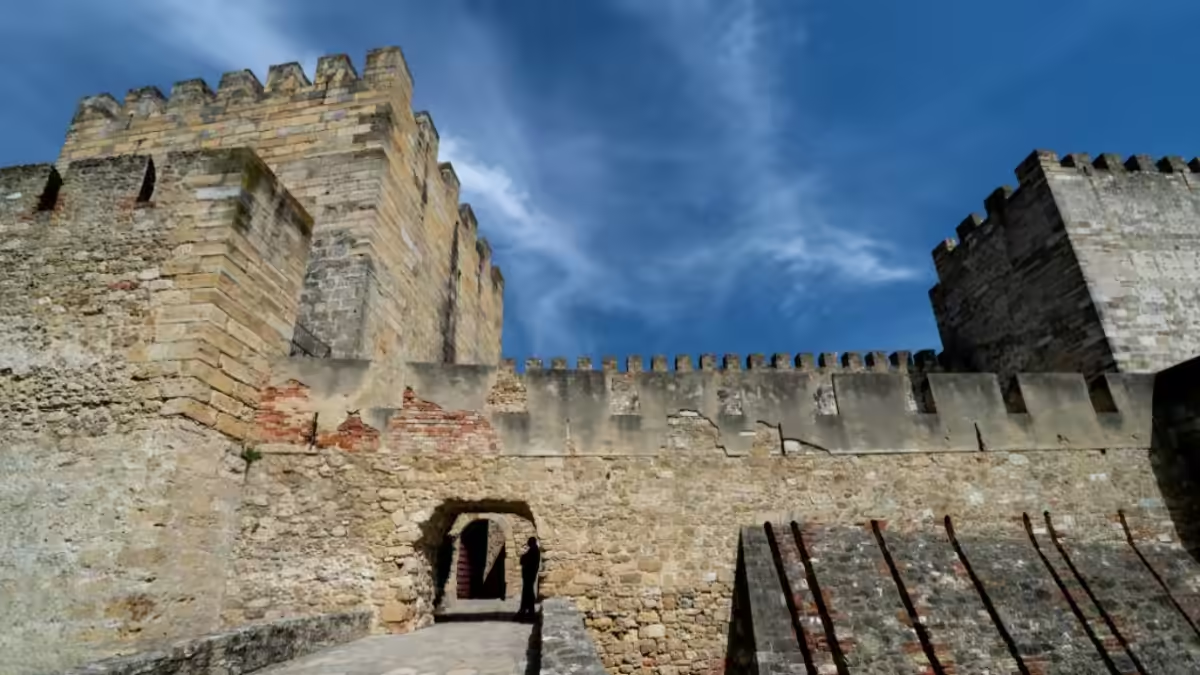
The medieval palace ruins at São Jorge Castle are what survives of the Paço Real da Alcáçova, the royal residence of Portuguese kings from the 13th to the early 16th century. You’ll find low walls, foundations and floor lines beside the archaeological site, rather than standing rooms. Read alongside the on-site exhibition, they show how a Moorish citadel became a working royal court before the kings moved down to the river.
Most visitors come to São Jorge Castle for the ramparts and the view, and it is easy to walk straight past the quieter ground where the real palace once stood. Yet for roughly three centuries this hilltop was not a fortress on the edge of the city but its royal heart — the Paço da Alcáçova, where Portuguese kings lived, held court and received ambassadors. What remains today is a set of ruins rather than a restored palace, and knowing what you are looking at changes the whole visit.
This guide explains what the Paço da Alcáçova was, what you can actually see of it now, how it sits within the wider archaeological site, and how to picture the medieval court that once filled these foundations.
What Was the Paço Real da Alcáçova?
The Paço Real da Alcáçova was the medieval royal palace inside São Jorge Castle, home to the kings of Portugal from the 13th century to the early 16th century. It grew out of the earlier Moorish citadel — “alcáçova” comes from the Arabic for a fortified enclosure — and became the seat of the court after Lisbon replaced Coimbra as the effective capital. It declined once the monarchy moved to a new riverside palace.
When Dom Afonso Henriques took the hill in the Siege of Lisbon in 1147, he captured a Moorish stronghold whose innermost, most defensible enclosure — the alcáçova — already held the ruler’s quarters. Over the following century the Portuguese crown adapted and expanded that enclosure into a proper royal palace. As Lisbon rose to become the kingdom’s principal city, the Paço da Alcáçova became the main residence of the monarchy, a place of government as much as a home.
The palace reached its height in the later medieval period, when kings such as João I held court here. It was under João I, in the late 14th century, that the castle was dedicated to St George, reflecting the Anglo-Portuguese alliance sealed by his marriage to Philippa of Lancaster. The court that gathered in these rooms was at the centre of a kingdom just beginning its age of maritime expansion.
What Remains of the Palace Today
Today the Paço da Alcáçova survives as ruins — low walls, wall lines, foundations and fragments of flooring set into the ground near the castle’s archaeological zone, not as roofed or furnished rooms. The palace fell out of royal use when the court moved to a riverside palace in the early 16th century, and later centuries of earthquake damage and military use erased most of what stood above ground.
Do not arrive expecting a stately-home interior. What you walk among are the excavated outlines of the palace: the bases of walls that once divided halls and chambers, thresholds where doorways stood, and patches of surviving floor that hint at the scale of the rooms. In places you can trace the plan of the building at ankle height, reading the layout from the stonework rather than from standing architecture.
The reasons for this are woven through the castle’s later history. When the monarchy left the hill for the Paço da Ribeira beside the Tagus in the early 16th century, the old palace lost its purpose and slowly decayed. The great earthquake of 1755 caused further destruction across the site, and for long stretches afterwards the castle served as military barracks, with little regard for the medieval fabric. The restoration of 1938–1940 stabilised the walls and towers, but the palace itself was already reduced to its footprint.
Take your time here and the ruins repay it. The audio guide included with the standard entry ticket and audio guide is genuinely useful at this point, because signage is limited and the stonework does not explain itself. If you would rather have the layers untangled in person, a Castle Guided Tour puts the palace ruins in the context of the whole hill’s story.
How the Ruins Connect to the Archaeological Site
The palace ruins do not stand alone. They sit within, and directly beside, the castle’s broader archaeological site, where excavations have peeled back layer after layer of occupation on the same ground. That is the key to understanding this corner of the castle: you are looking at one place used continuously for more than two and a half thousand years.
Beneath and around the medieval palace, archaeologists have uncovered remains from the Iron Age settlement that first fortified the hilltop, structures from the long period of Moorish rule, and the 15th-century palace layers themselves. The result is a compressed record of Lisbon’s history in a single dig — Iron Age, Moorish and medieval royal, stacked and overlapping. The palace of the Portuguese kings was simply the last great chapter written on ground that people had already been building on for millennia.
Because the site is delicate and partly below the surrounding level, walkways and viewpoints guide you around and over it. Move slowly, and use the interpretation to work out which walls belong to which era, since the periods sit so close together that they can blur into a single field of stone.
Reading the Ruins With the Exhibition
The ruins tell you where the palace stood; the permanent exhibition tells you how it was lived in. The exhibition displays artefacts excavated on this very site, spanning the Iron Age, Moorish and medieval periods, so the objects you see indoors came out of the ground you have just walked across. Seen together, the two make far more sense than either does alone.
Pairing them is the single best way to bring the court to life. A fragment of glazed ceramic, a coin or a piece of worked stone in the display case stops being an abstract exhibit once you have stood among the foundations it belonged to. Managed by EGEAC, Lisbon’s municipal culture company, the exhibition is arranged to frame this long occupation rather than to isolate the royal period, which is exactly why it complements the palace ruins so well.
Imagining the Medieval Court
To picture the medieval court, imagine the low ruins raised back into roofed halls and chambers looking out over the Tagus, filled with the household of a king who governed an expanding kingdom. From the 13th to the early 16th century this was where royal audiences, councils and daily palace life took place, before the court abandoned the hill for a new palace beside the river.
Stand at the palace ruins and let the setting do the work. The same commanding position that made this hill a fortress made it a fine place for a royal residence: light, air, and a sweep of view over the river that carried Portugal’s growing fleet. The kings who lived here were not distant medieval abstractions but rulers steering a country on the edge of the Age of Discovery, and their household filled these now-silent rooms with the business of governing.
It is worth remembering, too, why they eventually left. A hilltop palace behind thick walls was secure but inconvenient; the pull of the waterfront, closer to the docks and the trade that was making Lisbon rich, drew the court downhill. When they went, this palace was left to time. That slow abandonment is why you find ruins here rather than a living palace — and why the quiet is part of the atmosphere. For the fuller sweep of how the hill rose and fell, our guide to the castle’s history sets the palace years in their place.
Frequently Asked Questions
What are the medieval palace ruins at São Jorge Castle?
They are the surviving remains of the Paço Real da Alcáçova, the royal palace that stood inside the castle. From the 13th to the early 16th century it was the residence of Portugal’s kings. Today it survives as low walls, foundations and floor lines rather than standing rooms, set within the castle’s archaeological zone near the permanent exhibition.
Who lived in the Paço da Alcáçova?
The kings of Portugal lived here for roughly three centuries after Lisbon became the kingdom’s leading city. Among them was João I, under whom the castle was dedicated to St George in the late 14th century, linked to the alliance with England and his marriage to Philippa of Lancaster. The palace was both a royal home and the working seat of the medieval court.
Why is the palace in ruins?
The monarchy moved to a new palace beside the Tagus in the early 16th century, and the old hilltop palace lost its purpose and decayed. The 1755 earthquake caused further damage, and the castle later served as military barracks with little care for the medieval fabric. The 1938–1940 restoration stabilised the walls, but the palace was already reduced to its foundations.
Can you go inside the palace ruins?
There is no interior to enter, because the palace no longer has roofed rooms. Instead, walkways and viewpoints let you walk among and around the excavated wall lines and foundations. Because the ground is delicate and partly below the surrounding level, you follow the marked route rather than wandering freely across the stonework.
How do the ruins relate to the archaeological site?
The palace ruins sit within the wider archaeological site, where excavation has revealed Iron Age, Moorish and 15th-century palace layers on the same ground. The medieval royal palace is the latest major phase of an occupation stretching back more than two thousand years, which is why the different periods appear so close together in the dig.
How long should I spend at the palace ruins?
Allow around 20 to 30 minutes to take in the ruins and the surrounding archaeological remains properly, and longer if you pair them with the permanent exhibition next to them. It is easy to give the ruins only a passing glance, but slowing down to read the layout and the interpretation is what makes this part of the visit worthwhile.
Is there much to see, or just stones?
Honestly, if you expect a furnished palace you will be disappointed — this is a ruin, and much of it reads at ankle height. But with the audio guide or a little imagination it becomes one of the more rewarding parts of the castle, because you are standing where Portuguese kings actually governed. The nearby exhibition of excavated artefacts adds the human detail the bare foundations cannot.
Do I need a special ticket to see the palace ruins?
No. The palace ruins, the archaeological site and the permanent exhibition are all included in standard castle admission, such as the entry ticket and audio guide. There is no separate charge for this part of the site. Children up to 12 enter free and Lisboa Card holders are admitted free.
